
Why are the eggs of alligators in the wild more likely to hatch than those of farmed-raised gators? Ashley Picou Mikolajczyk is studying alligator egg yolks to find out.
鈥淚n the wild, a fertilized egg is almost guaranteed to hatch,鈥� she said. Studies suggest that about 95 percent of eggs hatch in the wild, compared to about 50 percent among captive animals.
Mikolajczyk, who鈥檚 pursuing a doctorate in chemical engineering, is comparing the fatty-acid profiles of eggs laid in the wild with those from captive alligators.
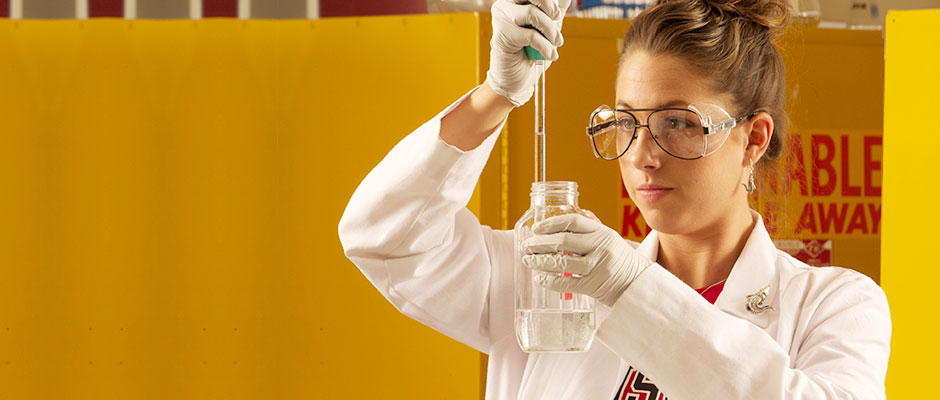
She measures a gram of yolk from each egg and uses a gas chromotography/mass spectrometry machine to separate the fatty acids. The machine forces the yolk sample through a narrow tube 鈥� roughly the diameter of a sewing needle 鈥� and breaks the material into its molecular components. It then 鈥渞eads鈥� the molecular chains of fatty acids.
In addition to comparing egg yolks from wild and captive animals, she is also comparing eggs from two groups of farm-raised alligators. One group was fed typical commercial food, the other was given commercial food fortified with fish oil.
鈥淚鈥檓 trying to determine whether there is a statistical difference that may indicate whether the enhanced food improved hatch rates,鈥� she explained.
The development of better commercial food could improve hatch rates for farmers and be used in the conservation of related species that are threatened and/or endangered, such as some crocodiles.